
Care Is Something You Carry – Carers Week 2026
Written by Dr David Palmer
As Carers Week highlights the contribution of millions of unpaid carers across the UK, I reflect on eight years of oral history interviews that revealed the hidden realities of mental health caring and inspired a public exhibition and poem built from carers’ own words.
The first thing Janet does every morning is check her phone. It is not a conscious decision so much as a habit acquired over years of supporting her son through recurring episodes of severe mental illness. Before she has fully woken, she is scanning for missed calls, messages or signs that something might be wrong. It is a small act, almost invisible in itself, yet it captures something many carers described during the interviews: the way responsibility settles into everyday life until it becomes part of who you are.
For almost 20 years Janet has supported her son through periods of crisis, recovery and uncertainty. Over time she has learned to notice things other people miss: subtle changes in his voice, shifts in routine, whether curtains have been opened, whether a text message arrives later than usual. When we met to record her oral history, she described this vigilance not as a burden but as a reality. “I don’t think people realise,” she told me. “Even when things are okay, you’re still watching. You’re still listening.”
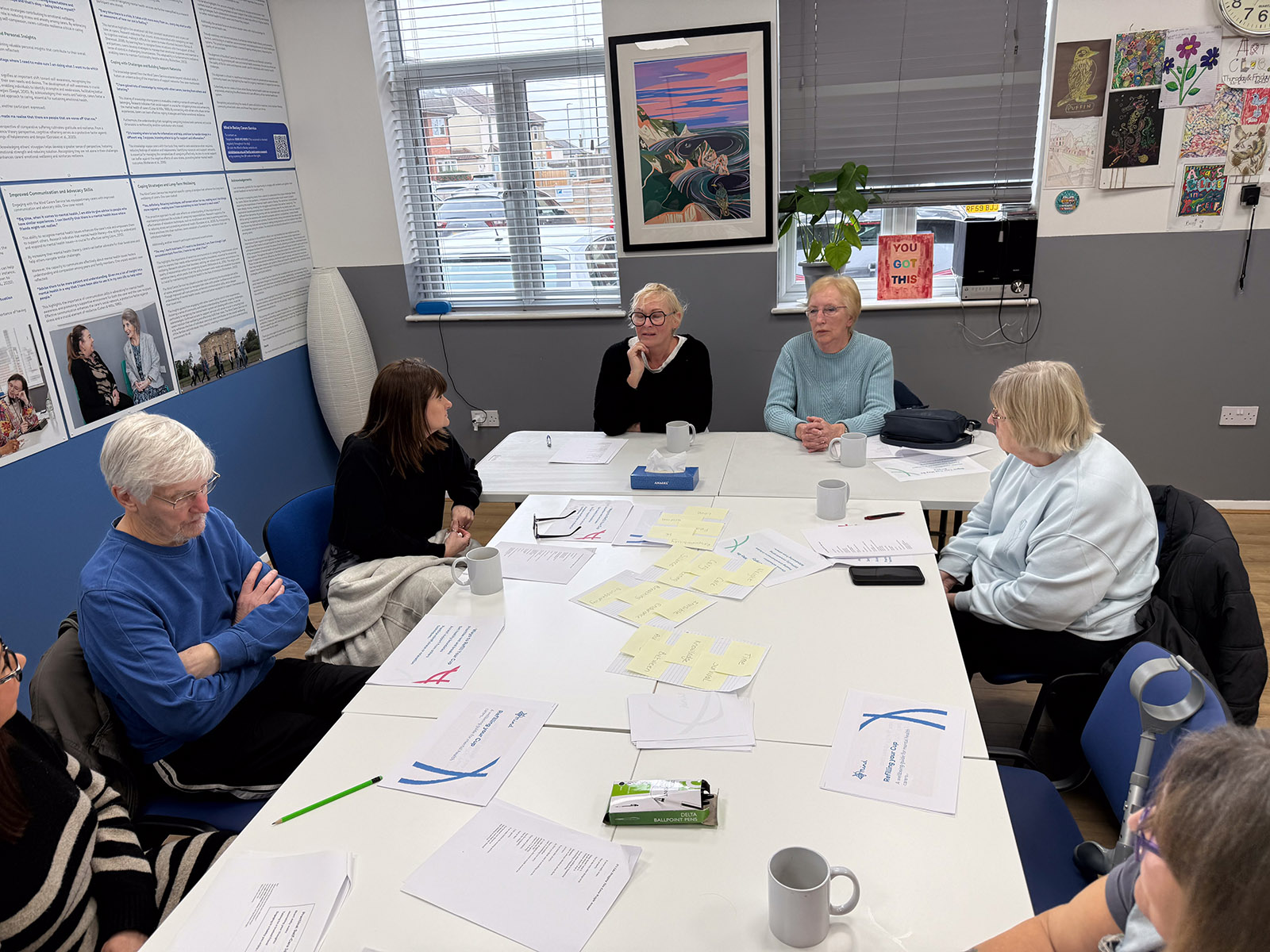
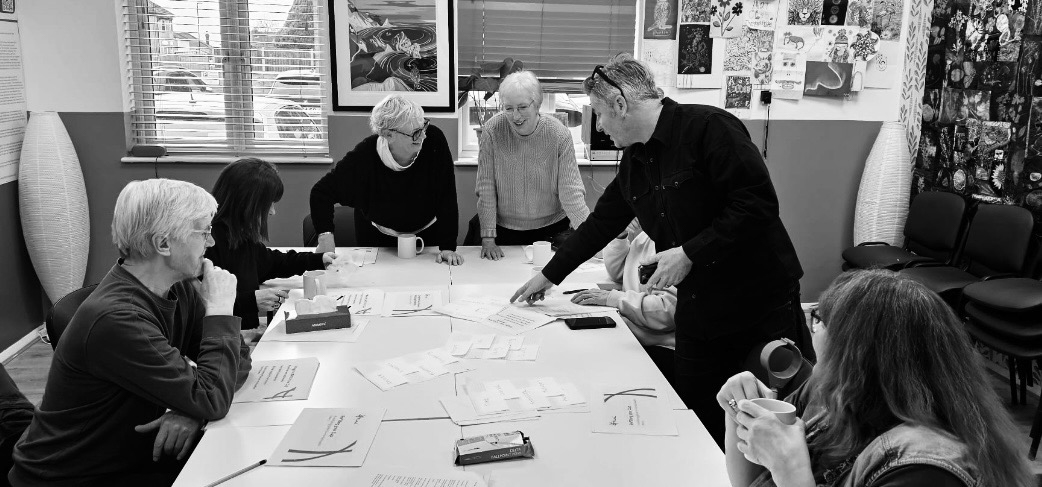
The carers group discussing their poem during a regular meeting at the Mind in Bexley office in Bexleyheath.
Janet is one of dozens of unpaid mental health carers whose stories I have had the privilege of hearing over the past eight years. During that time, I have interviewed parents caring for adult children, husbands supporting wives, wives supporting husbands, siblings supporting one another and adult children caring for ageing parents living with serious mental ill health. Their circumstances differed, as did the people they cared for, but what emerged from those conversations was a remarkably consistent picture of what caring actually feels like when experienced over years and sometimes decades.
Much public discussion of caring focuses on practical support: appointments, medication, paperwork and transport. These responsibilities matter, but they tell only part of the story. The carers I met spoke just as often about vigilance, uncertainty and emotional labour. They described carrying responsibility into workplaces, holidays, family gatherings and supposedly quiet evenings at home. Caring was rarely something that could be switched off. Instead, it became woven into everyday life.
One participant described living with what he called “permanent anticipation”. Every unknown phone number triggered a moment of anxiety. Every unexpected knock at the door produced a brief sense of dread. Rationally he knew that most calls brought ordinary news. Emotionally, years of experience had taught him that bad news could arrive without warning. Another participant spoke about sitting in cafés with friends while simultaneously monitoring her phone, not because she expected a crisis but because she knew crises rarely arrived at convenient times. “You never really switch off,” she told me, and variations of that phrase surfaced repeatedly throughout the project.
As the interviews accumulated, certain themes began to recur. One of the most striking was the language carers used to describe their experiences. Again and again, they reached for metaphors of weight, carrying and endurance. One woman compared caring to dragging a heavy object through life. Another described feeling permanently burdened by responsibility. A third spoke about existing in a state of constant readiness, as though braced for impact. What united these accounts was not simply exhaustion but the sense that caring had become something they carried with them wherever they went.
For Michael, caring had arrived gradually. When his wife first became unwell, he assumed life would eventually return to normal. He accompanied her to appointments, offered emotional support and took on additional responsibilities around the house. Then more responsibilities appeared. Years later, he found himself struggling to identify where caring ended and ordinary life began. “It just happened,” he reflected. “At first you’re helping. Then you’re supporting. Then one day you realise your whole life revolves around making sure somebody else is okay.”
What was striking about Michael’s story, and many others, was the absence of self-pity. Carers rarely described themselves as victims. They spoke instead about responsibility, commitment and love. For all the exhaustion, frustration and loneliness they described, their stories were fundamentally rooted in relationships. Again and again people returned to the same explanation: “I love them.” Not as sentiment, but as fact.
Yet love does not protect people from isolation. Susan, who cared for her adult daughter, described how her social world gradually contracted over time. Friends stopped inviting her to events because she so often had to cancel at short notice. Conversations became harder because her daily experiences felt increasingly different from those around her. “People were kind,” she reflected. “They just didn’t understand.” Her observation echoed throughout the project. The problem was rarely hostility. It was invisibility.
The exhibition that eventually emerged from these interviews sought to address precisely that problem.
Developed collaboratively with carers, it brought together oral histories, photography, recorded testimony and creative work.
Visitors encountered not statistics but people. They listened to stories of vigilance, exhaustion, humour, resilience and love. Many left surprised by what they had heard. Some recognised aspects of their own families in the stories. Others admitted they had never previously considered the realities of unpaid mental health caring. The exhibition revealed not only how common these experiences are, but how rarely they enter public conversation.
It was while reviewing transcripts, recordings and exhibition material that a poem began to emerge. Carers repeatedly returned to the same images and metaphors. They spoke about carrying weight, waiting for crises, listening for danger and living between services and loved ones. Gradually, these fragments formed a collective narrative. The resulting poem, It’s Like Dragging This Extra Weight Around, was constructed from the language of the interviews themselves. Rather than interpreting carers’ experiences from outside, it attempts to listen from within them. What follows is not intended to speak for carers but to preserve something of what they shared. It is a collective voice built from years of testimony, conversation and listening.
It’s Like Dragging This Extra Weight Around,
It never really stops.
Not properly.
Not in the way other things stop.
Sleep doesn’t stop it.
Work doesn’t stop it.
Silence doesn’t stop it.
Even when nothing is happening
everything is happening.
Because
you’re always thinking about them.
Always.
You learn this slowly.
At first you think care is something you do.
Then you realise
care is something you carry.
It’s like dragging this extra weight around me
through my life,
wherever I’m going,
whatever I’m doing.
They said it plainly.
Not for sympathy.
Not for effect.
Just as fact.
Like gravity.
You wake before the morning arrives.
Not because you choose to
but because your body has learned
that listening is survival.
You listen
for footsteps
that aren’t there.
For doors
that shouldn’t open.
For silence
that has changed its meaning.
You get hypersensitive to things,
one carer explained.
You know them more than the doctors do.
You learn their breathing.
You learn the difference
between breathing
and not coping.
Between quiet
and withdrawal.
Between stillness
and danger.
You carry knowledge
no one officially gave you.
You carry risk
no one officially assigned you.
You carry responsibility
without permission.
You’re kind of between,
someone said.
Between the person that’s ill
and the mental health team.
Between
means holding both sides
without being held yourself.
Between
means translating fear
into acceptable language.
Between
means knowing
and not being heard.
You try to explain.
I tried to tell them something was wrong.
But explanation requires authority.
And care does not grant authority.
It grants proximity.
It grants consequence.
It grants responsibility
without power.
Time rearranges itself.
You stop planning years ahead.
You plan hours.
You plan moods.
You plan outcomes
that cannot be planned.
I feel like I’m in a tumble dryer,
one mother said,
like an old trainer really,
just battering around
and not knowing
which direction to go.
This is what care does.
It removes direction.
It replaces it
with endurance.
You begin to disappear quietly.
Not all at once.
In increments.
You stop mentioning your tiredness.
You stop mentioning your fear.
You stop mentioning yourself.
Because love remains.
Always love remains.
Even when exhaustion replaces hope.
Even when exhaustion replaces you.
I love them,
they said.
As explanation.
As justification.
As fact.
Care is not heroic.
It is repetitive.
It is ordinary.
It is invisible.
It is listening
when no one else is listening.
It is staying
when no one else is staying.
It never really stops.
But sometimes
very occasionally
someone sits beside you
and does not ask you to explain.
They already understand.
And in that moment
the weight does not disappear
but shifts
just enough
for you
to breathe.
The poem ends with a small act of recognition. The weight does not disappear. There is no miraculous solution, no sudden relief from responsibility. Instead, somebody sits beside a carer and understands. After years of listening to unpaid mental health carers, I have come to believe that this moment matters more than we often acknowledge.
This Carers Week provides an opportunity not only to recognise unpaid carers but to listen more carefully to what they have been telling us for years. The interviews revealed that carers do not simply provide support; they hold together families, sustain recovery, navigate fragmented systems and absorb the emotional consequences of crises. Yet despite this, many continue to feel unseen within the very structures they help sustain. Today, policymakers increasingly talk about prevention, neighbourhood care, community resilience and integrated support. These are important conversations. Yet throughout this project I was repeatedly struck by the fact that carers have long been doing much of this work already. They connect fragmented services, sustain relationships, prevent crises and provide continuity when systems fall short. They possess forms of knowledge that emerge not from professional training but from lived experience.
If we are serious about creating more compassionate, community-based systems of support, carers cannot remain an afterthought. Their expertise must be recognised. Their wellbeing must matter. Their voices must be heard.
Most importantly, we must remember that behind every statistic about caring lies a human story: a mother checking her phone before dawn, a husband monitoring messages during dinner, a daughter listening for changes in a loved one’s voice. These are not extraordinary acts performed by extraordinary people. They are ordinary acts of care carried out every day, often without recognition.
As Carers Week reminds us, millions of people continue to provide care that is essential yet often invisible. The carers who shared their stories taught me that care is rarely dramatic. More often it is repetitive, uncertain and quietly enduring. Above all, they taught me that caring is not simply something people do.
It is something they carry.
And perhaps the most meaningful thing we can do this Carers Week is ensure they no longer have to carry it alone.
Further information about our Carers Service
If you would like more information about our Carers Service and the support it provides, please visit our Carers webpage
To view our exhibition about Carers, the PDF of the exhibition download it here